Quick answer
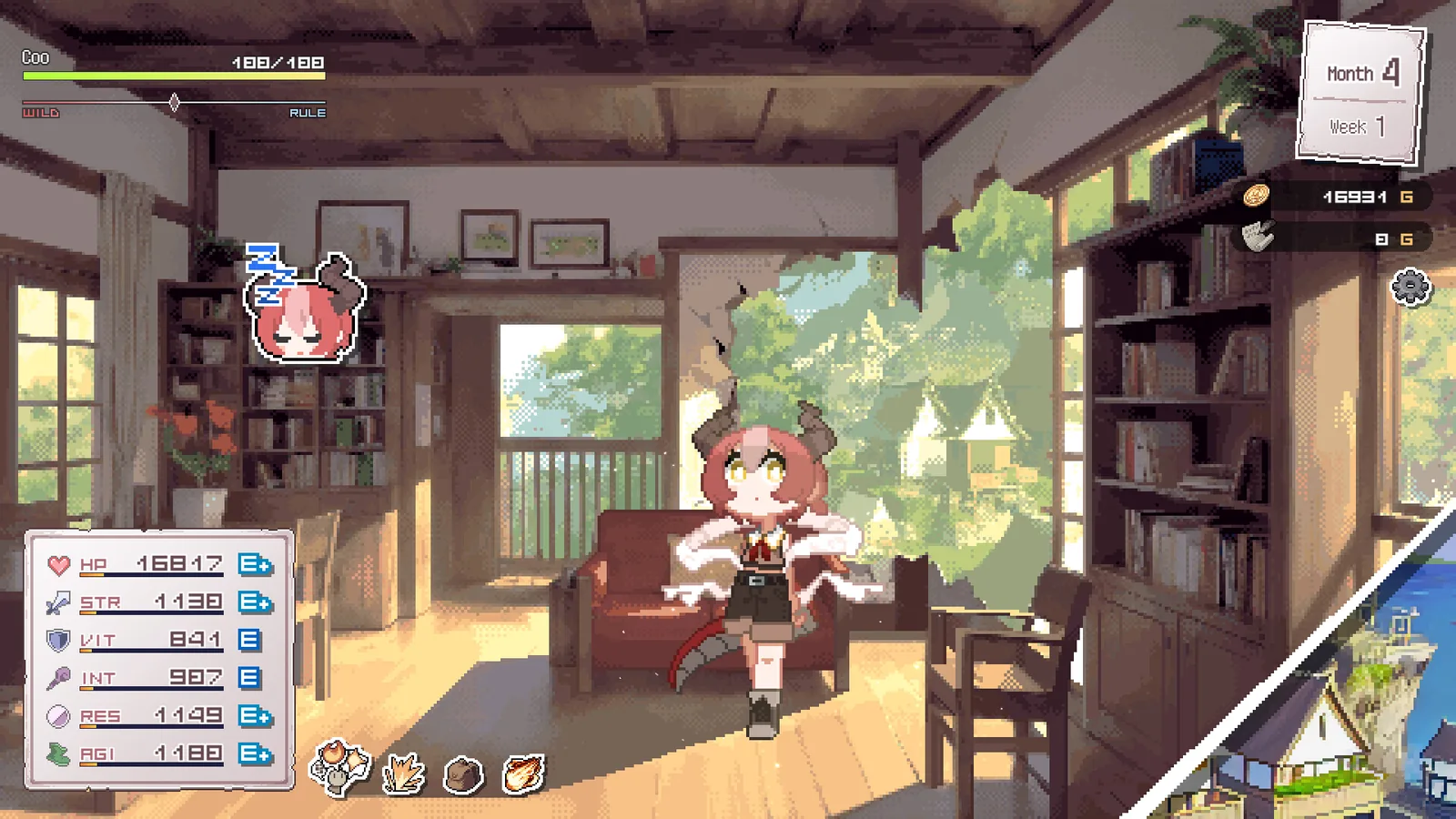
A DRAPLINE build is three decisions stacked on each other: which side of the WILD↔RULE bar you live on, which stats you feed, and which skill family you collect three of. The two archetypes the community actually writes about are a WILD crit build that wins through direct damage, and a RULE buff-and-damage-over-time build that also carries a fifth battle-skill slot.
There is no official build guide. The store page describes three orientations — powerful attacks, defence and recovery, and poison-type weakening — but no numbers, and 1.0.0 rebalanced 13 skills without publishing the new values.
The two archetypes, and what each costs
| WILD — crit and direct damage | RULE — buffs, debuffs and damage over time | |
|---|---|---|
| Why it works | When the dragon ignores your command she lands a guaranteed critical hit, so hard-hitting direct attacks and claw skills that gain from criticals scale with her disobedience. | Buffs you apply last one turn longer and debuffs on enemies last one turn shorter, which suits poison, wind blade and shield play. |
| Extra upside | She eats the remains of defeated enemies completely, so stat gains from battles are larger, and predation options show up more often in events. | A strong RULE tendency raises the battle-skill cap from four to five. |
| Cost | Ignoring a command means you do not get the turn you planned, and the wiki records higher damage taken while she ignores you. | Partially eaten enemies give smaller stat gains, and at the extreme she stops eating human enemies entirely. |
| Good first fit | An INT/AGI setup with three or four large-damage or claw skills, per the player who wrote the most detailed Steam post on the topic. | Any plan that wants extra turns of poison or wind blade, or that needs the extra skill slot to hold a defensive option. |

Feeding decides the stats underneath the build
Stats come from food, not from experience, so the build plan starts at the kitchen. This mapping is the one a community field guide records; its author warns it was written during Early Access and should be checked against current tooltips before spending a week on it:
| Stat you need | Food type to look for | Secondary stats it also feeds |
|---|---|---|
| HP | Carbohydrates; bones | Bones also give AGI |
| STR | Meat; eggs | VIT |
| VIT | Metal; stone | STR |
| INT | Seafood; crystals | RES |
| RES | Trees; fungi | INT |
| AGI | Plants; water | HP |
Skills that show up in build notes
The Japanese wiki keeps the most detailed tables. Their values carry no update date and sit under the 1.0 rebalance, so read them as components rather than current numbers:
- Hunting Instinct B — passive critical rate +10%.
- Muscle Focus A — passive physical damage +20% at the cost of 5% accuracy.
- Reflex A — passive critical damage +40%, again with −5% accuracy.
- Self-Confident — passive that grants 8 BP every time a critical lands, which links a crit build to faster Dragon Breath.
- Magic Pressure — passive follow-up hit after any magic attack, scaling from STR × 0.5.
- Wind Gust — clears every buff on the target and applies a wind blade; wind blade damage is also an achievement target above 30,000.
- Vital Shield — a shield equal to VIT × 2 that absorbs damage outright.
- Curse — magic attack whose damage equals the total damage you have taken, capped at your own max HP; a natural partner for a defensive run.
- Dancing Chop — medium damage, multiplied by 1.5 on odd turns and 0.5 on even turns.
- Lick Wounds — healing that grows the further the personality sits on the WILD side.
Where the skills come from
Skills are grouped into six families — horn, claw, wing, scale, roar and neutral — and helping a villager raises the rarity of one family while also improving what the shops offer. The wiki pairs Martha with horn skills and with metal and crystal rarity, Arches with claw, Quin with scale, Knot with fang, Ulupica with roar and Toly with wing; helping Morgentiana produces ingredient discounts instead.
Learning three skills of the same family triggers a synergy that behaves like a permanent passive, and the official achievements track those synergies at Lv.1, Lv.2 and Lv.3. The tiers are the closest thing to a build-objective system the game ships with.
What makes build advice expire
Version 1.0.0 changed 13 skills — five buffs and eight cooldown reductions — and published none of the new values. Everything in this page is therefore a structural description rather than a table to copy. The crit percentages attributed to the WILD passive (+50 to +100% critical chance, +25 to +50% damage taken while ignoring commands) come from a single wiki and are not corroborated anywhere else.
If you want the numbers behind these choices, the skills page collects the community tables with their dates attached, and the personality page explains the alignment effects that the build is built on.
Sources
Official orientation names and the 1.0 rebalance come from Steam. Every specific value is community data with its date noted.
- Steam store page — DRAPLINE“over 200 different skills”; attack, defence and poison orientations, accessed 29 September 2026
- Steam news — 1.0.0 update notes13 skills adjusted without published values, 24 September 2026
- Steam discussion — managing the alignmentcommunity build reasoning for WILD and RULE, posts from July–September 2025
- Drapline Wiki (Fandom) — Coocommunity wiki, alignment passives and synergy rule
- h1g DRAPLINE wiki — battle and passive skillscommunity skill values, no update date, possibly outdated
- h1g DRAPLINE wiki — actionscommunity wiki, villager help and skill family rarity
- DRAPLINE field guide — feeding and CPcommunity guide with an Early Access disclaimer; food mapping
- SteamHunters — DRAPLINE achievementscommunity tracker, synergy tiers and damage achievements
Page added 29 September 2026. Source check performed 29 September 2026.